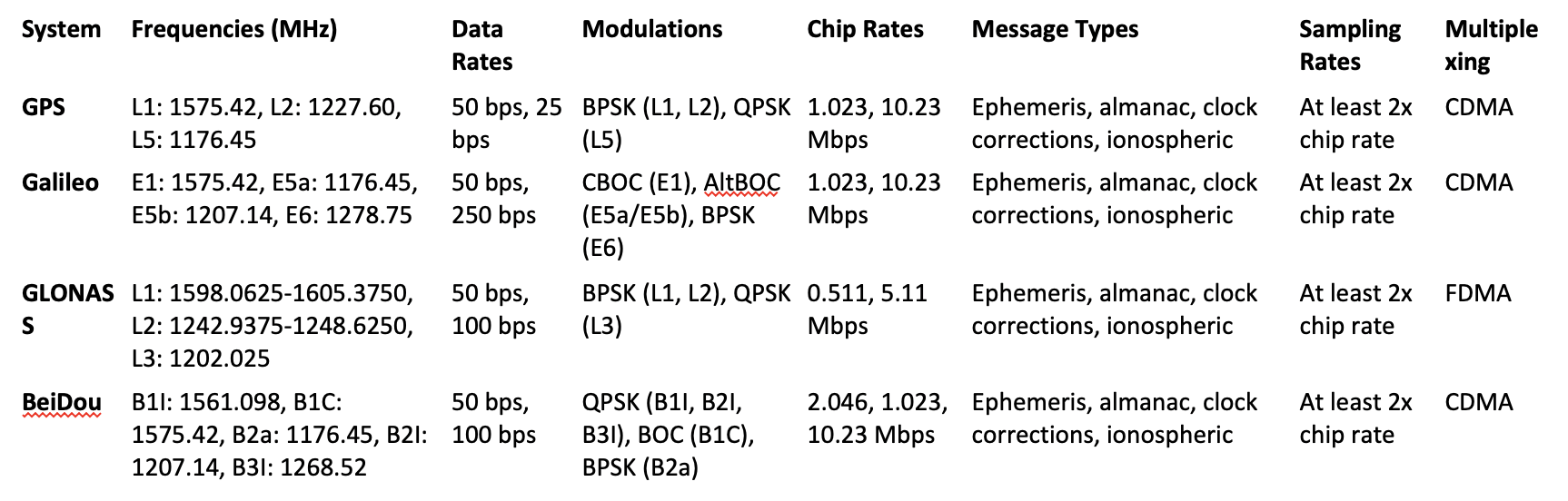
Summary of GNSS Signal Characteristics
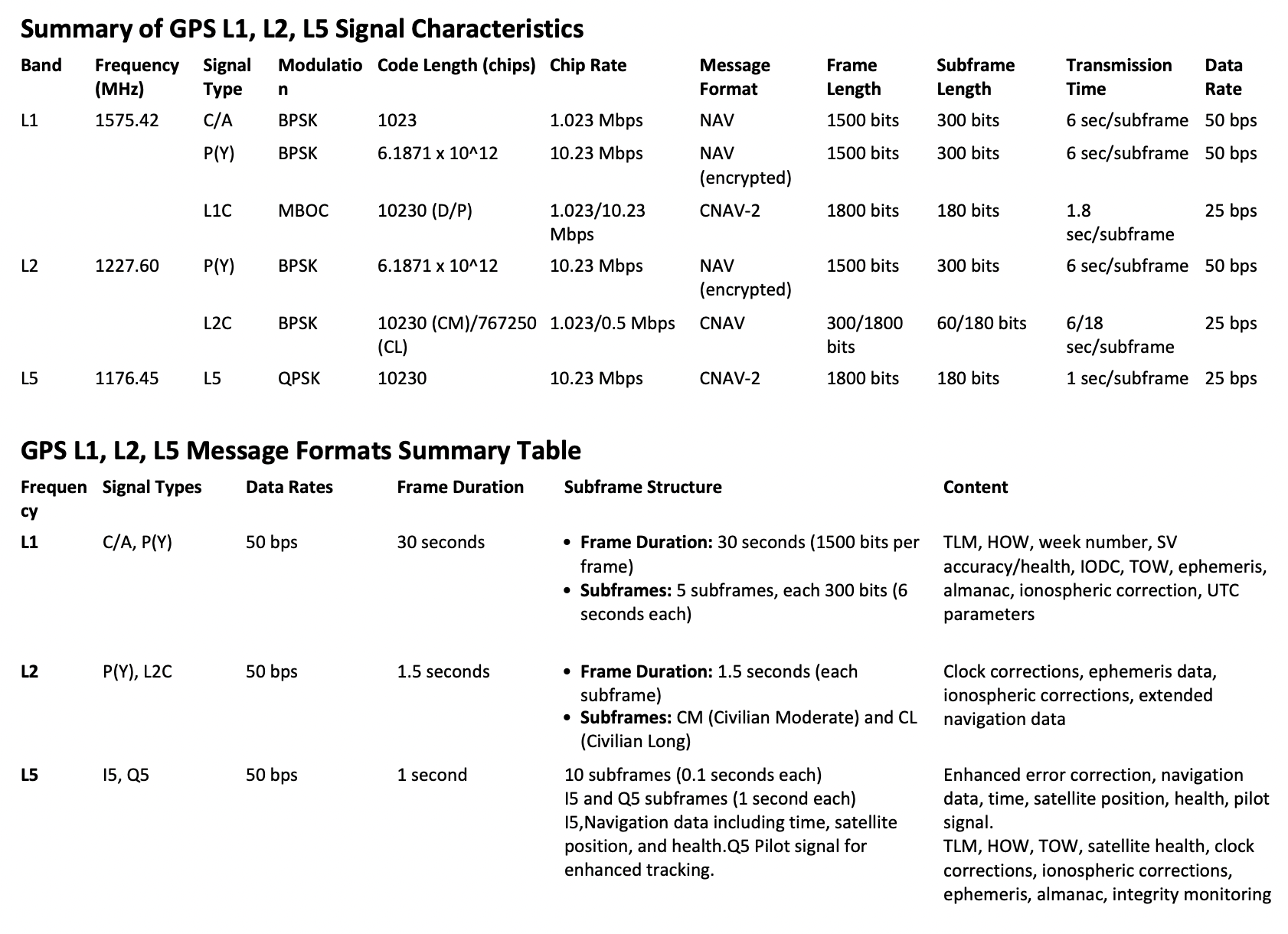
1. Summary of GPS L1, L2, L5 Signal Characteristics
1.1 GPS L1 C/A Navigation Message structure and format
The content of every sub-frame is as follows:• Sub-frame 1: contains information about the parameters to be applied to satellite clock status for its correction. These values are polynomial coefficients that allow converting time on board to GPS time. It also has information about satellite health condition.
• Sub-frames 2 and 3: these sub-frames contain satellite ephemeris.
• Sub-frame 4: provides ionospheric model parameters (in order to adjust for ionospheric refraction), UTC information (Universal Coordinate Time), part of the almanac, and indications whether the Anti-Spoofing, A/S, is activated or not (which transforms P code into the encrypted Y code).
• Sub-frame 5: contains data from the almanac and the constellation status. It allows to quickly identify the satellite from which the signal comes. A total of 25 frames are needed to complete the almanac.
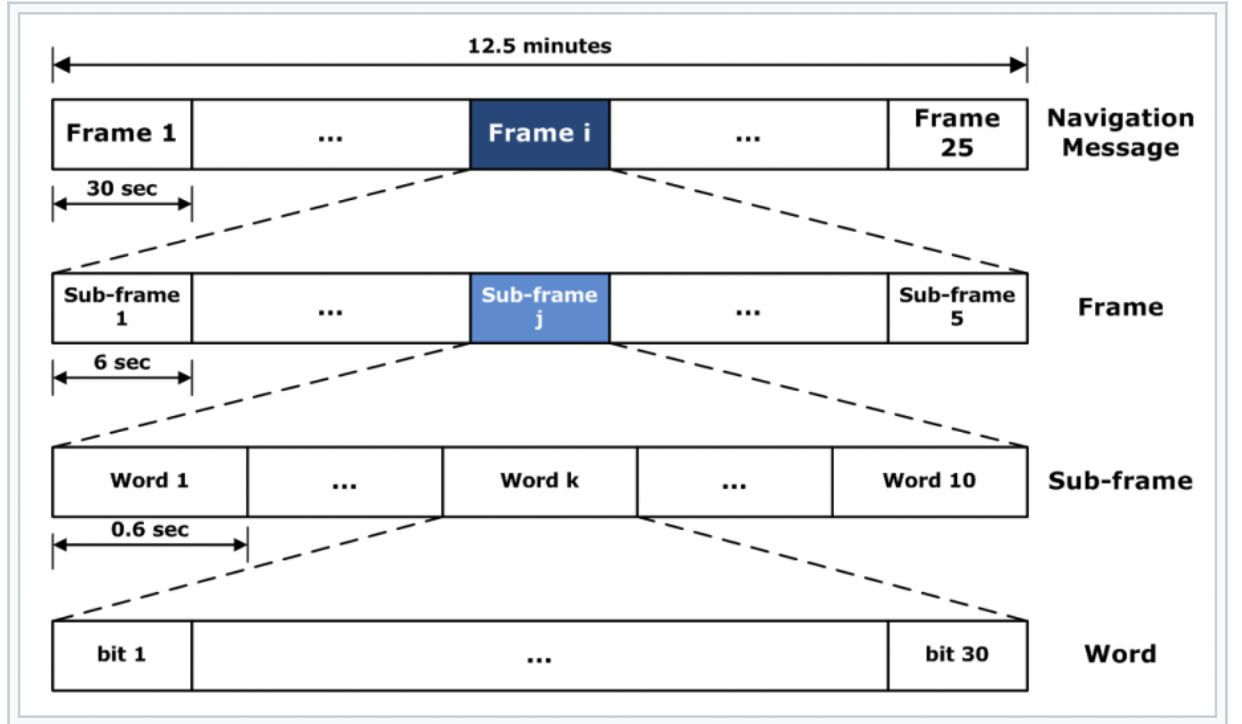
Sub-frames 1, 2 and 3 are transmitted with each frame (i.e., they are repeated every 30 seconds). Sub-frames 4 and 5 contain different pages (25 pages each) of the navigation message (see figure 1). Thence, the transmission of the full navigation message takes 25 × 30 seconds = 12.5 minutes. The content of sub-frames 4 and 5 is common for all satellites. Thence, the almanac data for all in orbit satellites can be obtained from a single tracked satellite.
L1 C/A Signal
• Data Rate: 50 bps
• Frame Duration: 30 seconds
• Frame Structure: Each frame is 1500 bits long, composed of 5 subframes, each 6 seconds long.
L1 C/A Signal Subframe
• Subframe 1:
○ Telemetry (TLM): 30 bits
○ Handover Word (HOW): 17 bits
○ Time of Week (TOW): 17 bits
○ Satellite Clock Corrections: 256 bits
○ Issue of Data (IODC): 8 bits
• Subframe 2:
○ Ephemeris Data: Satellite position in orbit, including precise time, velocity, and acceleration (information about the satellite's position at any given time).
• Subframe 3:
○ Ephemeris Data Continuation: Additional ephemeris data, including clock correction data and the satellite's status.
• Subframes 4 and 5:
Almanac Data: Coarse orbit and status data for all satellites in the constellation. Also includes ionospheric model parameters and UTC data.
1.2 GPS L2 Navigation Message structure and format
L2C Signal• Data Rate: 25 bps (L2 CM) and 50 bps (L2 CL)
• Frame Duration: 30 seconds
• Frame Structure: Each frame is composed of two segments: Civil Moderate (CM) and Civil Long (CL).
L2C Signal Subframe
• Civil Moderate (CM) Subframe:
○ Length: 20 milliseconds
○ Content: Clock corrections, ephemeris data, ionospheric corrections.
• Civil Long (CL) Subframe:
○ Length: 1.5 seconds
Content: More precise ephemeris and clock data, along with additional navigation data.
1.3 GPS L5 Navigation Message structure and format
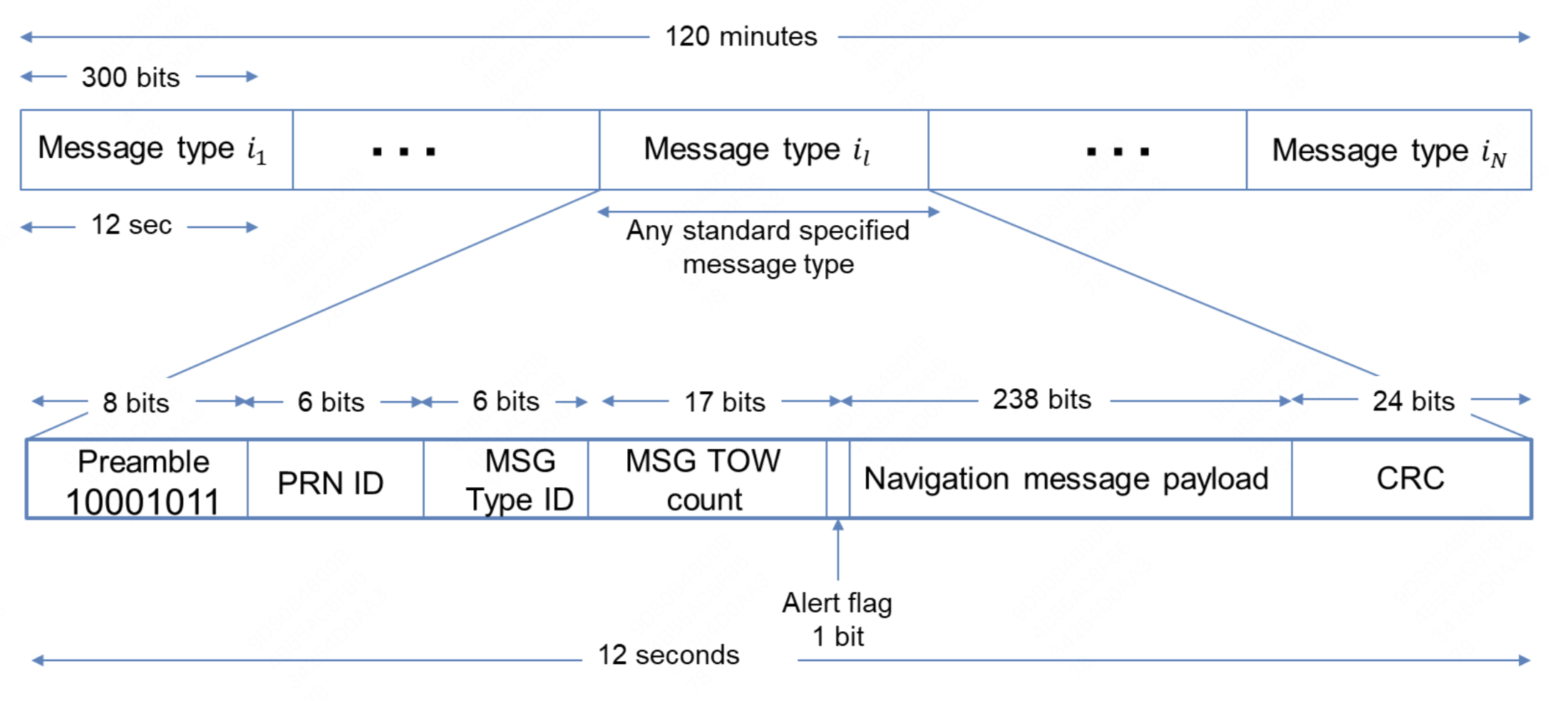
L5 Signal• Data Rate: 50 bps (I5)
• Frame Duration: 1 second
• Frame Structure: Each frame consists of 10 subframes, with each subframe being 1/10th of a second.
L5 Signal Subframe
• Subframe 1:
○ TLM (Telemetry Message): 8 bits
○ Preamble: 8 bits
○ HOW (Handover Word): 16 bits
○ Time Data: Time of week, week number, etc.
• Subframes 2 to 10:
Navigation Data: Includes clock corrections, satellite health, ionospheric corrections, ephemeris, and almanac data.
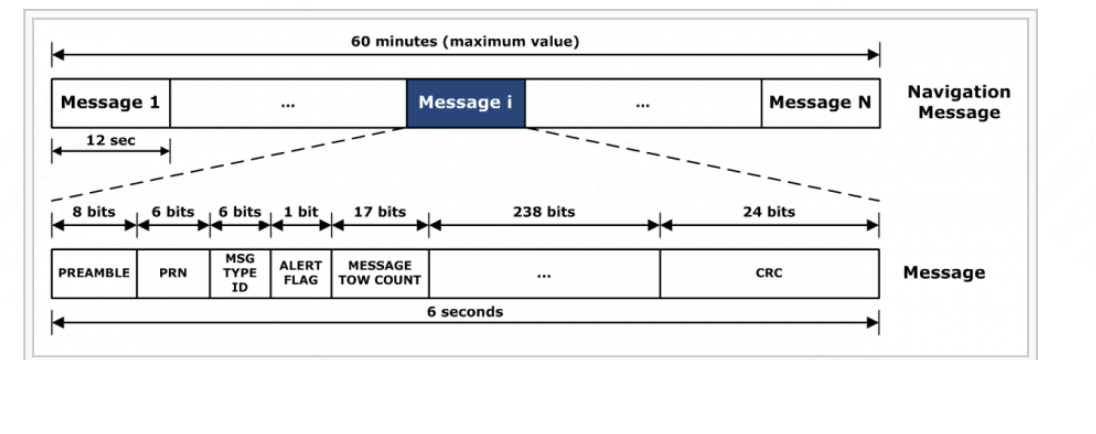
2. Summary of Beidou B1i B2i B3i Signal Characteristics
2.1 Beidou B1i Navigation Message structure and format
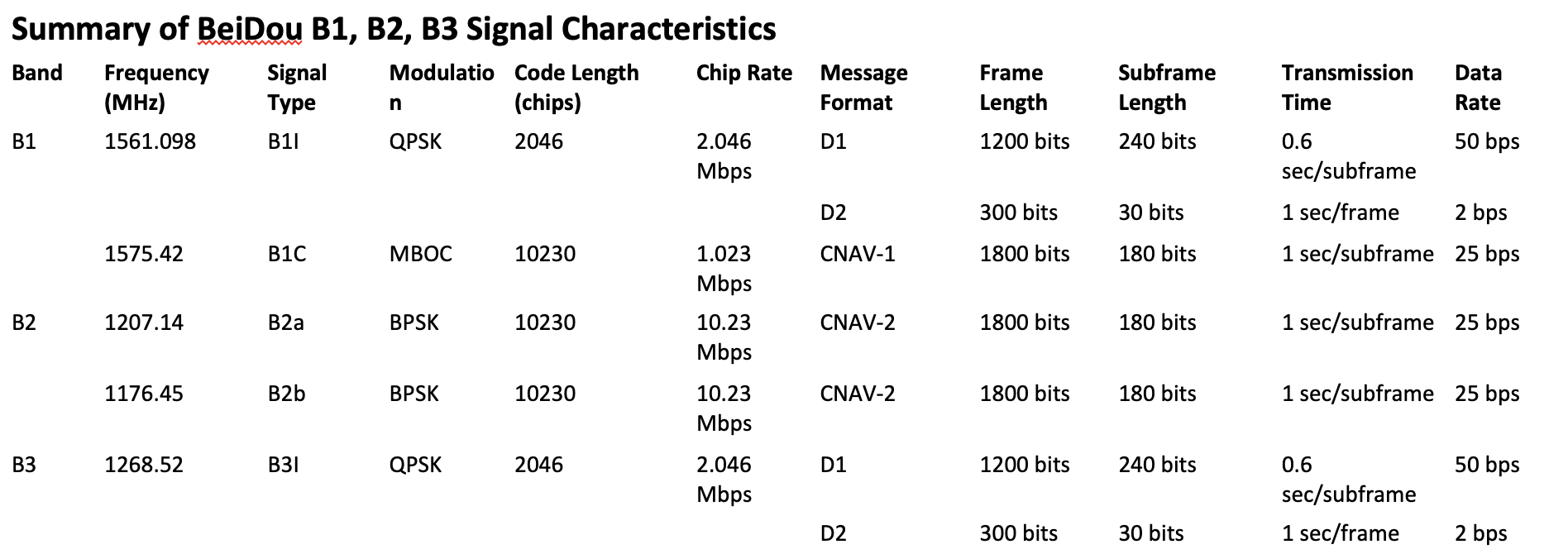
 Signal Characteristics
• Frequency: 1561.098 MHz
• Data Rate: 50 bps
• Modulation: Binary Phase Shift Keying (BPSK)
• Access: Code Division Multiple Access (CDMA)
• Chip Rate: 2.046 Mbps
B1I/B2I Signal (D1 Format)
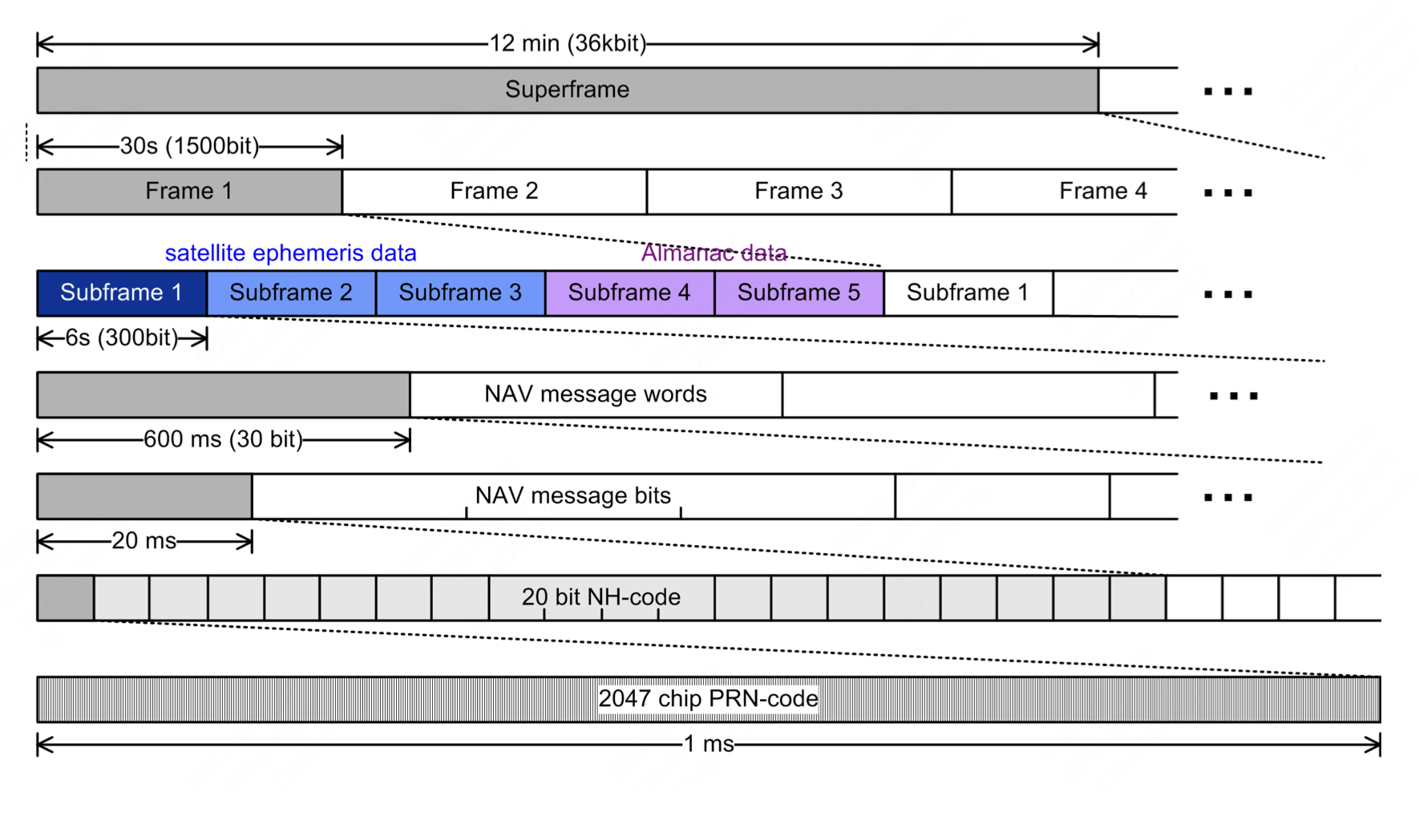
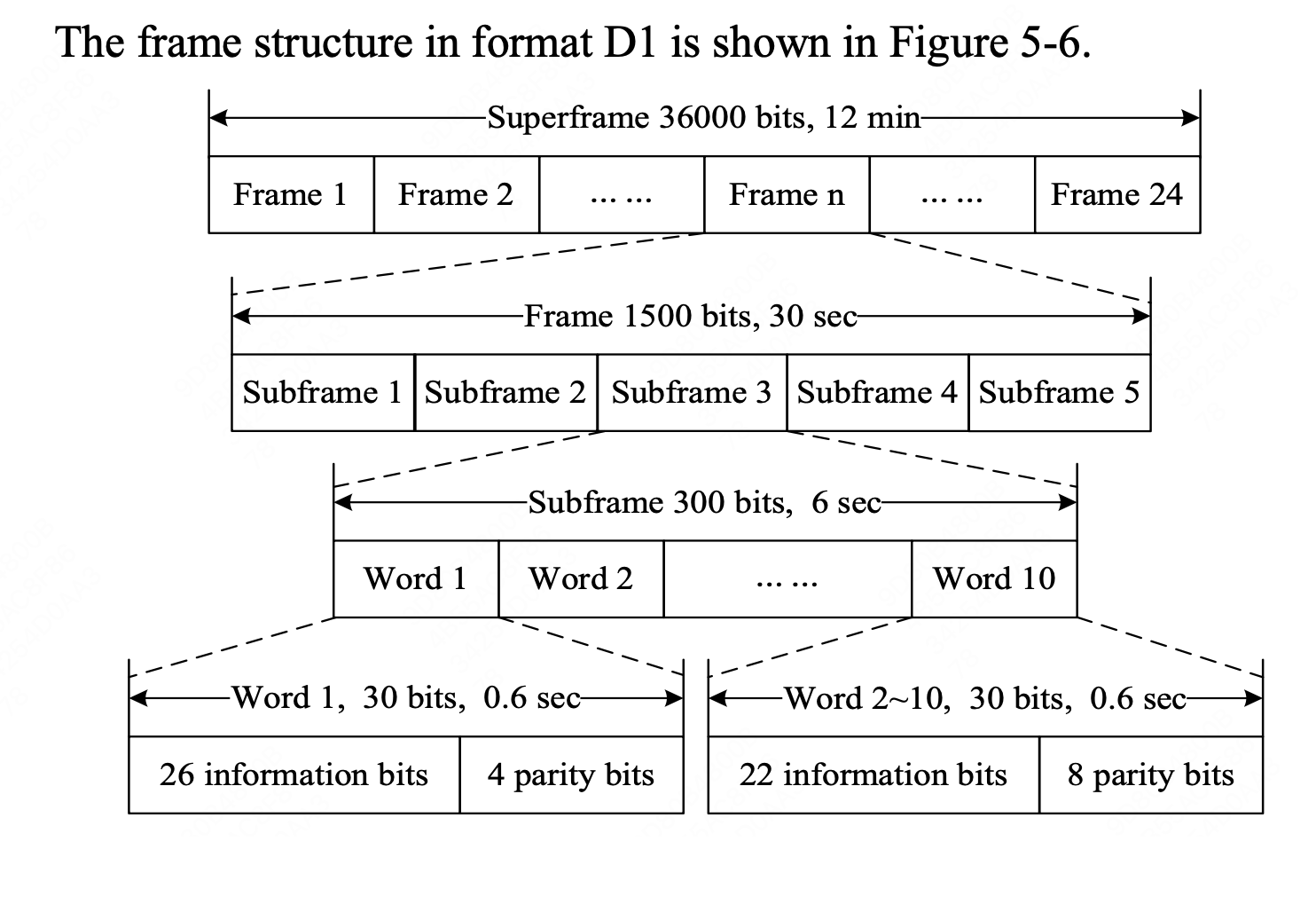
Every superframe has 36000 bits and lasts 12 minutes.
Every superframe is composed of 24 frames (24 pages).
Every frame has 1500 bits and lasts 30 seconds. Every frame is composed of 5 subframes.
Every subframe has 300 bits and lasts 6 seconds.
Every subframe is composed of 10 words.
Every word has 30 bits and lasts 0.6 second
D1 Subframe Format (B1I, B2I)
• Subframe 1:
○ Preamble: 8 bits
○ Satellite Health: 6 bits
○ Satellite Status: 10 bits
○ Issue of Data (IOD): 10 bits
○ Time of Week (TOW): 17 bits
• Subframe 2:
○ Ephemeris: 76 bits (provides precise satellite position data)
• Subframe 3:
○ Clock Corrections: 104 bits (provides the necessary corrections for accurate timing)
• Subframe 4:
○ Ionospheric Corrections: 74 bits (provides information to correct for ionospheric delay)
• Subframe 5:
Almanac Data: 85 bits (provides coarse orbital data for the satellite constellation)
2.2 Beidou B2i Navigation Message structure and format
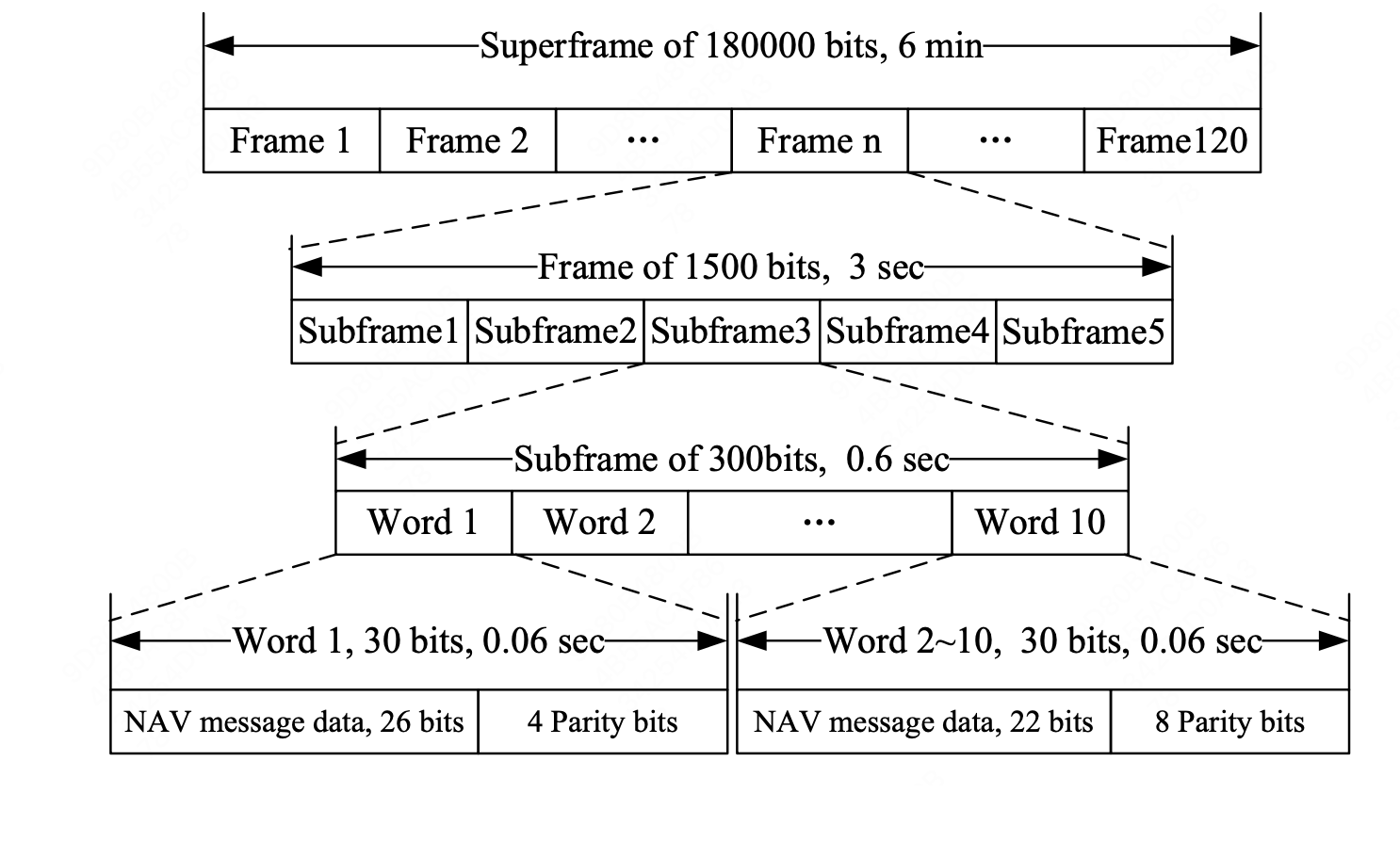
B1I/B2I Signal (D2 Format)Every superframe is 180000 bits long, lasting 6 minutes.
Every superframe is composed of 120 frames each with 1500 bits and lasting 3 seconds.
Every frame is composed of 5 subframes, each with 300 bits and lasting 0.6 second.
Every subframe is composed of 10 words, each with 30 bits and lasting 0.06 second.
B1I/B2I Frame Signal (D2 Format)
• Data Rate: 500 bps
• Frame Duration: 3 seconds
• Frame Structure: Each frame is divided into several subframes, each with a duration of 3 seconds.
D2 Subframe Format (B1I, B2I)
• Subframe 1:
○ Navigation Data: Contains essential satellite status and health data.
• Subframe 2:
○ Ephemeris: Provides detailed information about the satellite's position and velocity.
• Subframe 3:
○ Clock Corrections: Time synchronization information.
• Subframes 4 & 5:
○ Almanac and Auxiliary Data: Provides information about other satellites in the constellation and other relevant parameters.
2.3 Beidou B3i Navigation Message structure and format
Signal Characteristics• Frequency: 1268.520 MHz
• Data Rate: 50 bps (for the navigation message)
• Modulation: Binary Phase Shift Keying (BPSK)
• Chip Rate: 10.23 Mbps
• Access: Code Division Multiple Access (CDMA)
Frame and Subframe Structure
The B3I signal transmits its navigation message using a structured format that includes frames and subframes.
• Frame Duration: 6 seconds per frame
• Subframes per Frame: Typically, each frame is divided into subframes, each carrying different types of navigation data.
• Complete Navigation Message: The full message is structured over multiple frames, with repetition to ensure data integrity.
B3I Signal Subframe Structure
• Subframe 1:
○ Telemetry (TLM): Contains the initial synchronization information.
• Subframe 2:
○ Ephemeris Data: Precise orbital parameters for the satellite.
• Subframe 3:
○ Clock Data: Corrects the satellite's onboard clock.
• Subframe 4:
○ Ionospheric Data: Corrections for ionospheric delays.
• Subframe 5:
Almanac Data: Coarse orbit data for all satellites in the constellation.
3. Summary of Galileo E1,E5a,E5b Signal Characteristics
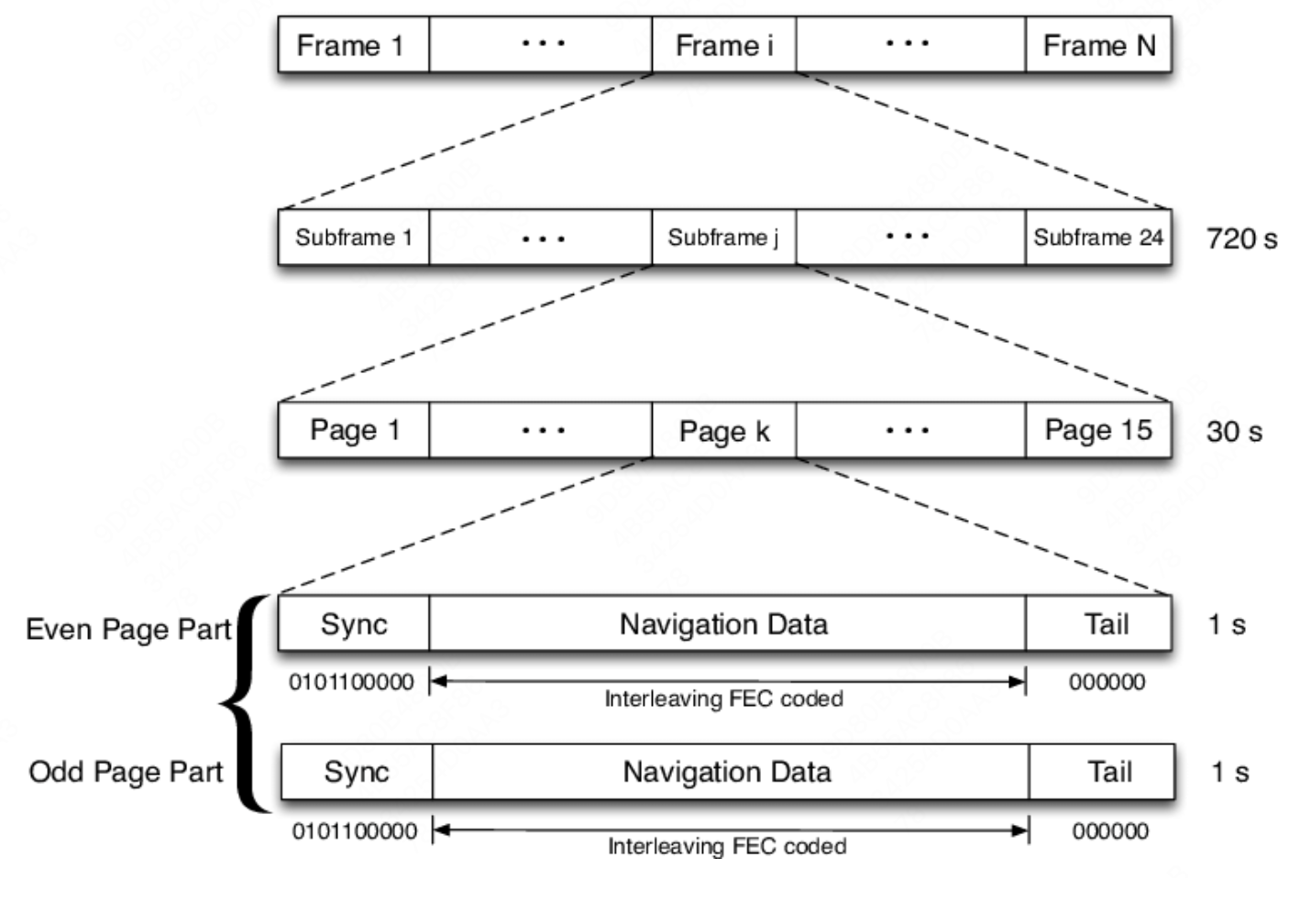
 Details of Message Structures
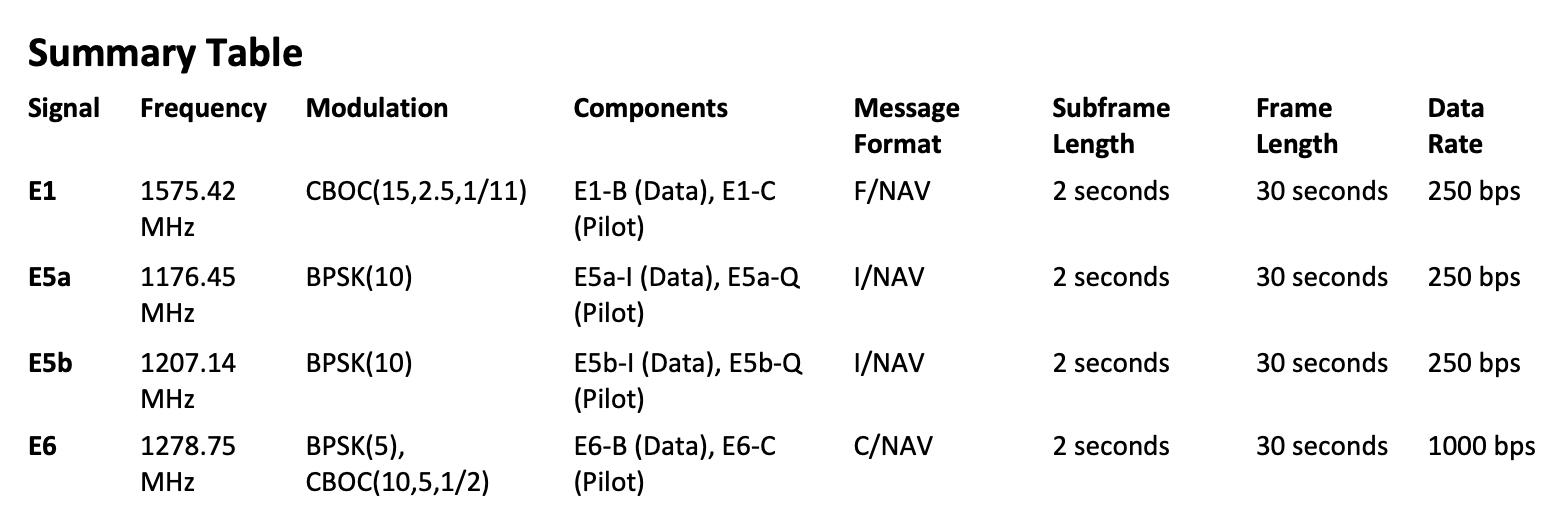
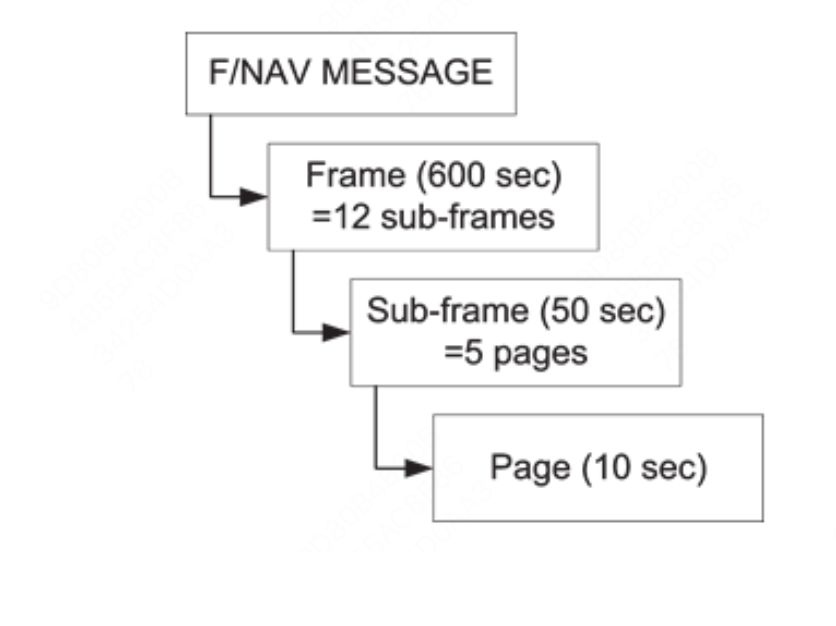
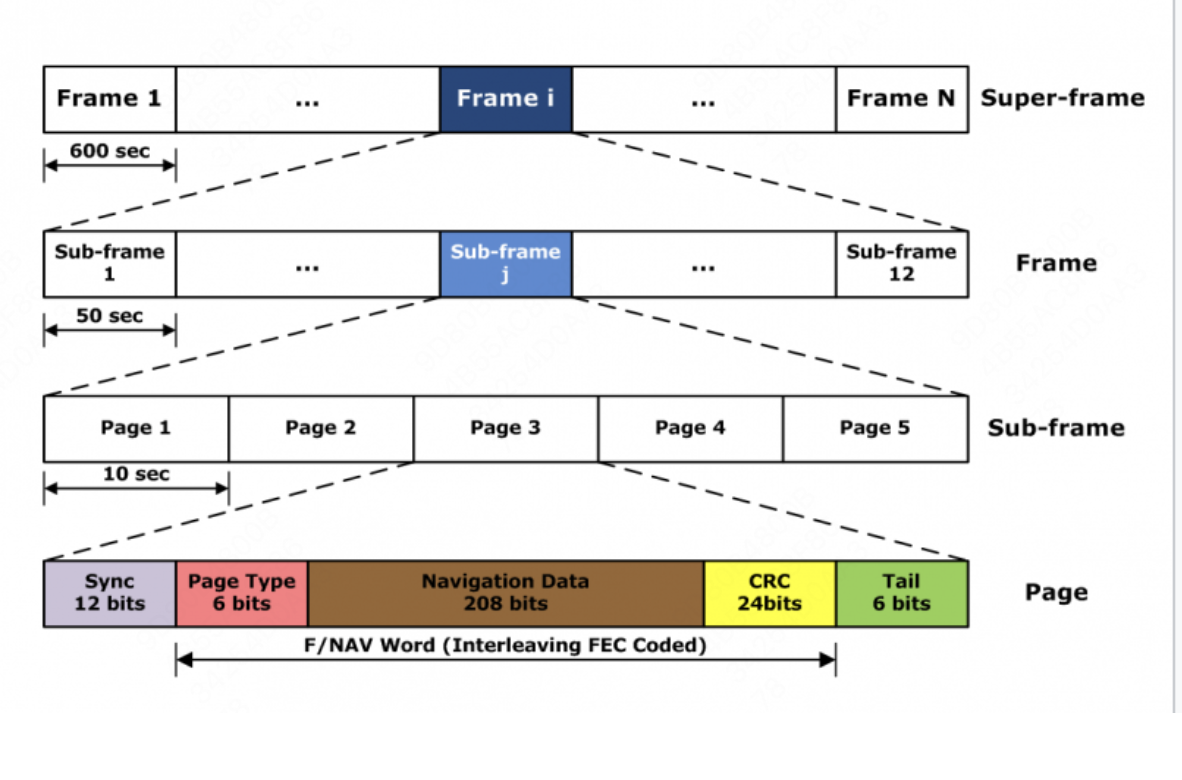
• F/NAV (E1-B): Contains ephemeris data, satellite clock corrections, ionospheric and integrity information. Designed for open service with high reliability.
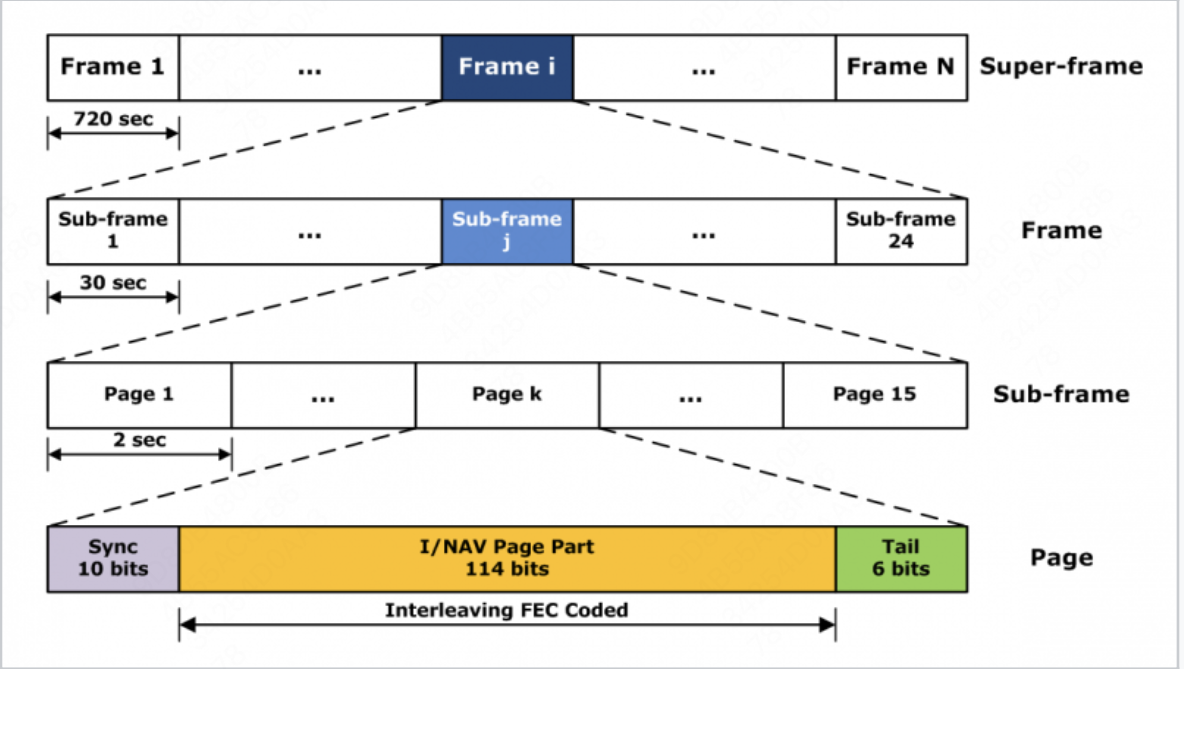
• I/NAV (E5a-I, E5b-I): Broadcasts data with a focus on integrity, essential for safety-critical applications. Also includes ephemeris, clock, and ionospheric corrections.
• C/NAV (E6-B): Aimed at commercial services, offering higher precision, additional commercial features, and a higher data rate for improved service quality.
These signals are carefully structured to meet the diverse needs of Galileo users, from general navigation to high-precision and commercial applications.
3.1 Galileo F/NAV Navigation Message structure and format
3.2 Galileo F/NAV Navigation Message structure and format
4. Summary of Glonass L1 C/A,L2 C/A Signal Characteristics
 Key Points
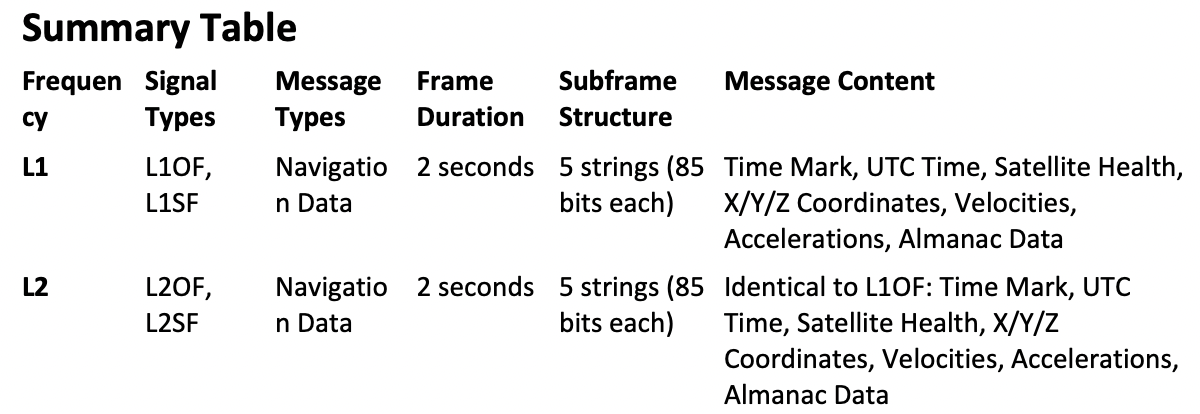
• L1OF and L2OF: Provide standard accuracy navigation and timing data for civilian users.
• L1SF and L2SF: Encrypted signals for military or authorized users.
• Message Structure: Consists of 5 strings per frame, each containing essential satellite and navigation data, including ephemeris (position, velocity, acceleration) and almanac (coarse orbital data for the constellation).
• Frame Duration: Each frame lasts 2 seconds, and the navigation data is continuously updated.
This structured approach ensures that the GLONASS system provides accurate and reliable positioning data across its global coverage area.
4.1 Glonass L1 C/A Navigation Message structure and format
4.2 Glonass L1 C/A Navigation Message structure and format
Message FormatsL1OF and L2OF:
• String 1 (85 bits):
○ Time Mark (2 bits)
○ Current Time (27 bits)
○ Satellite Health (4 bits)
○ X Coordinate (18 bits)
○ X Velocity (18 bits)
○ X Acceleration (11 bits)
○ Reserved (5 bits)
• String 2 (85 bits):
○ Time Mark (2 bits)
○ Current Time (27 bits)
○ Satellite Health (4 bits)
○ Y Coordinate (18 bits)
○ Y Velocity (18 bits)
○ Y Acceleration (11 bits)
○ Reserved (5 bits)
• String 3 (85 bits):
○ Time Mark (2 bits)
○ Current Time (27 bits)
○ Satellite Health (4 bits)
○ Z Coordinate (18 bits)
○ Z Velocity (18 bits)
○ Z Acceleration (11 bits)
○ Reserved (5 bits)
• String 4 (85 bits):
○ Almanac Data (85 bits): Contains the almanac for other satellites, including coarse orbital information, health, and status.
• String 5 (85 bits):
Almanac Data Continuation (85 bits): Further almanac data for the satellite constellation.